


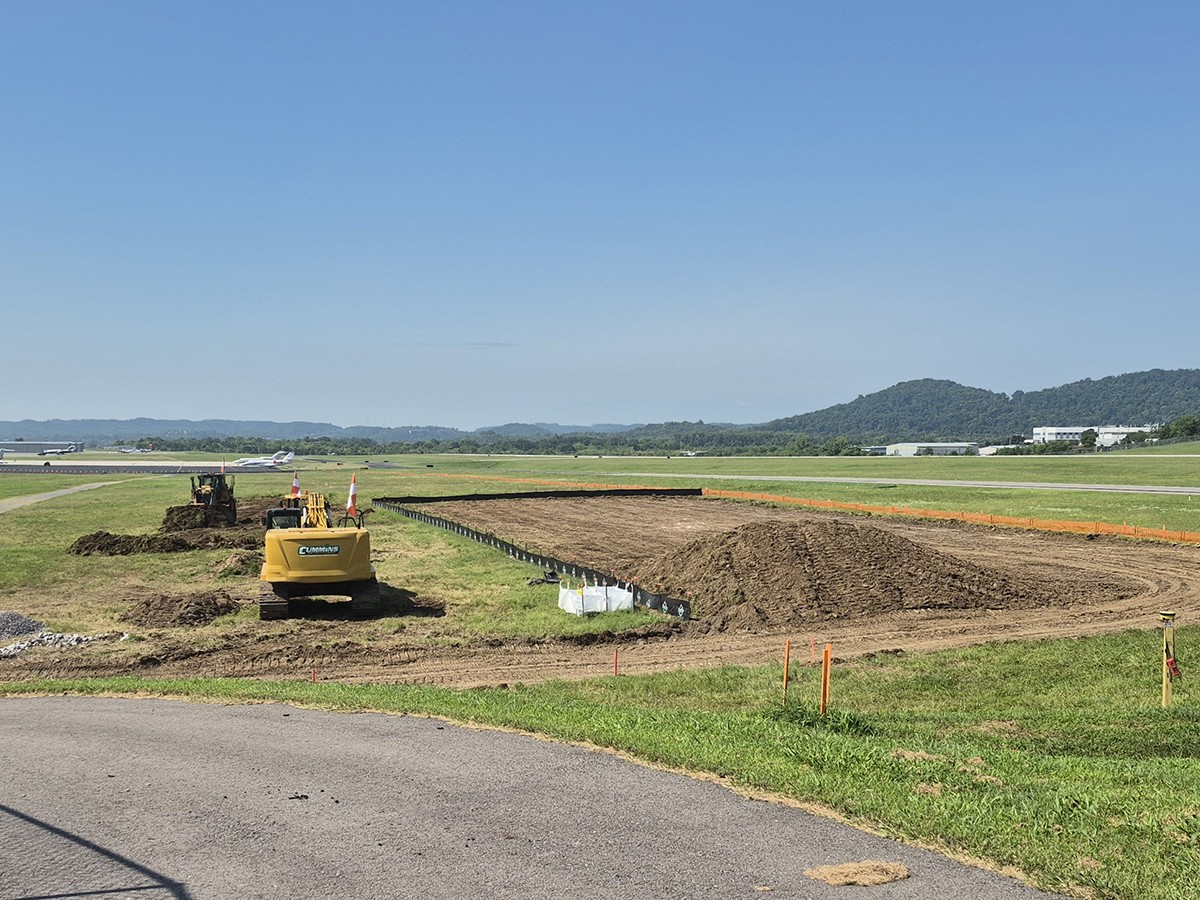
Atlantic Aviation Begins Construction on New State-of-the-Art FBO at John C. Tune Airport®
Atlantic Aviation today announced that construction is underway on its first facility at John C. Tune Airport®, also known as JWN®, marking a significant milestone in the company’s planned expansion within the Nashville market and supporting the continued growth of business aviation in Middle Tennessee.
Construction activities are now underway on Atlantic’s highly anticipated executive fixed-based operator (FBO) terminal, following the company’s successful award through the Metropolitan Nashville Airport Authority’s competitive RFP process. Located just eight miles west of downtown Nashville, JWN serves as a vital gateway for general aviation and an increasingly important complement to Nashville International Airport®, also known as BNA®. Both airports are owned and operated by the Metropolitan Nashville Airport Authority.
Atlantic’s new facility at JWN is designed to deliver a modern, elevated experience for customers while supporting the operational needs of today’s business aviation community. The development will include a 7,500-square-foot executive FBO terminal, a 37,000-square-foot hangar and office complex capable of accommodating a full range of business aviation aircraft, and approximately 175,000 square feet of new ramp space. Additional infrastructure will include a 60,000-gallon Jet-A fuel farm, 12,000 gallons of 100LL fuel capacity, and a dedicated de-icing pad. The project is expected to be completed in Q4 2027.
In alignment with Atlantic’s long-standing commitment to sustainability, the project will incorporate environmentally responsible design and construction practices, including LEED-focused elements, efficient building systems, and strategies to minimize construction waste.
“Seeing construction begin at John C. Tune Airport is an exciting milestone for Atlantic Aviation and our partnership with the Metropolitan Nashville Airport Authority,” said Jeff Foland, Chief Executive Officer of Atlantic Aviation. “Nashville continues to be one of the most dynamic markets in the country, and this investment reflects our long-term commitment to supporting the region’s growth with state-of-the-art aviation infrastructure, exceptional service, and expanded access for business aviation customers.”
“John C. Tune Airport plays a vital role in supporting the region’s growing general aviation community, and Atlantic Aviation’s expansion marks a major step forward in strengthening that access for the Nashville area,” said Doug Kreulen, president and CEO of the Metropolitan Nashville Airport Authority. “By bringing world‑class facilities and services to John C. Tune Airport, Atlantic Aviation is helping us position the airport for long‑term success, and we’re excited for the expanded opportunities this investment will create for our customers and for Middle Tennessee.”
Atlantic has assembled a proven team of industry partners to bring the project to life. Margulies Hoelzli Architecture, a nationally recognized aviation consulting firm based in New York, serves as the project architect, continuing its collaboration with Atlantic on several developments across the U.S. Benesch will serve as the project’s civil engineer, leading site grading, utilities, and paving design. PRO Building Systems of Atlanta has been selected as the general contractor, bringing extensive experience from prior Atlantic projects, including Nashville International Airport. The fuel farm will be designed and constructed by American Environmental Aviation, Inc., a long-time partner on numerous Atlantic locations nationwide.
Atlantic’s new JWN facility further strengthens its investment in the Nashville market, complementing its recently completed state-of-the-art FBO at BNA and providing customers with expanded access, capacity, and service options across the region.
Atlantic Aviation and the Metropolitan Nashville Airport Authority look forward to celebrating the completion of the project with the aviation community upon the facility’s opening, which is anticipated in late 2027.

